
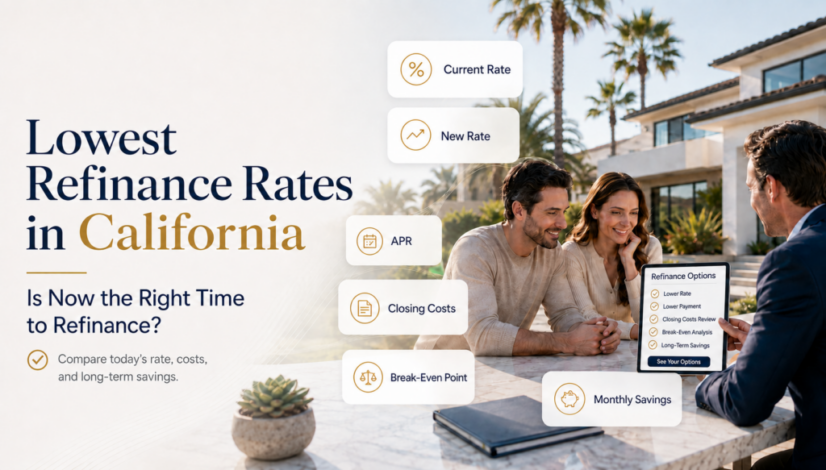
Lowest Refinance Rates in California – Is Now the Right Time to Refinance?
For many California homeowners, refinancing becomes a serious question the moment they see a lower interest rate online. But the right time to refinance is not based on headlines alone. It depends on your current mortgage, your financial goals, your closing costs, and how long you expect to keep the loan.
The latest published Freddie Mac Primary Mortgage Market Survey on its mortgage rates page shows the average U.S. 30-year fixed-rate mortgage at 6.30% and the 15-year fixed-rate mortgage at 5.64% as of April 30, 2026. Freddie Mac also notes those averages were 6.23% and 5.58% the prior week, showing that rates can move even within a short period. These are national benchmarks, not guaranteed personal offers, but they are useful starting points for refinance timing decisions.
At The Lending Mamba, we help California homeowners understand whether refinancing actually improves their position — not just whether a new rate looks lower.
What Does “Lowest Refinance Rate” Really Mean?
Many homeowners search for the “lowest refinance rates in California,” but the lowest advertised rate is not always the best refinance deal.
Your actual refinance offer depends on your credit score, home equity, loan amount, debt-to-income ratio, property type, occupancy, loan term, lender pricing, and whether you are paying discount points. A low advertised rate may also come with higher upfront costs, lender fees, or points.
That is why the smarter question is not only, “Can I get a lower rate?” It is also, “Will this refinance help me save money in a way that fits my goals?”
Is Now the Right Time to Refinance?
The answer depends on your situation.
A refinance may make sense if it helps you lower your monthly payment, reduce your interest rate, shorten your loan term, switch from an adjustable rate to a fixed rate, remove mortgage insurance if eligible, or access equity through a cash-out refinance.
But the Consumer Financial Protection Bureau warns that refinancing usually comes with many of the same costs as getting your original mortgage, and its “Should I refinance?” handout says it may not make sense if you plan to move soon, if your home value has fallen significantly, if your credit standing has declined, or if your current mortgage has a prepayment penalty.
What Is the Break-Even Point?
Your break-even point is the number of months it takes for your refinance savings to recover your closing costs.
If your refinance saves you $200 per month and your closing costs are $4,800, your break-even point is about 24 months. If you expect to keep the mortgage longer than that, the refinance may be worth considering. If not, it may not.
This is one of the most important calculations in refinance planning.
Compare Loan Estimates Carefully
The CFPB says a Loan Estimate tells you important details about the mortgage loan you requested and recommends getting multiple Loan Estimates from different lenders so you can compare and choose the loan that is right for you. The CFPB also says comparing Loan Estimates helps you decide which lender offers the best deal, and that you should focus on the loan amount, interest rate, total monthly payment, upfront loan costs, lender credits, and cash to close.
That matters even more when refinancing, because two loans with similar rates can have very different upfront costs.
No-Cost Refinance? Look Closer
Some homeowners are attracted to “no-cost refinance” ads. But “no closing cost” does not always mean there are no real costs.
The CFPB explains that some lenders may advertise loans as having no lender fees or no closing costs, but there are still services and costs involved in originating a mortgage. In practice, those costs may be covered through a higher rate, rolled into the loan, or offset in another way.
So if you see a no-cost refinance offer, review how those costs are being handled before assuming the loan is cheaper.
Common Reasons to Refinance
1. Lower Your Interest Rate
This is the most common goal. If your new rate is meaningfully lower than your current rate and the closing costs make sense, refinancing may create real savings.
2. Lower Your Monthly Payment
Some homeowners refinance to create more monthly cash flow. This can help with budgeting, but you should still review the long-term cost.
3. Shorten Your Loan Term
Moving from a 30-year loan to a 15-year loan may reduce total interest paid and help you build equity faster. Freddie Mac’s latest published averages show the 15-year fixed rate lower than the 30-year average, which can make this option worth reviewing for some homeowners.
4. Switch Loan Structure
You may want to move from an adjustable-rate mortgage to a fixed-rate mortgage for stability.
5. Take Cash Out
Some homeowners use cash-out refinancing to access equity for renovations, debt consolidation, or other major financial goals. But cash-out should be reviewed carefully because it can increase your balance and long-term borrowing cost.
How California Homeowners Should Think About Timing
For California homeowners, the “right time” to refinance should be based on your numbers, not just the market.
Ask these questions:
- What is my current rate?
- What new rate and APR can I actually qualify for?
- What are my estimated closing costs?
- How long is my break-even point?
- How long do I plan to keep this home or loan?
- Am I refinancing for savings, stability, cash-out, or a shorter term?
If the refinance supports a clear financial goal, then timing may be right — even if rates are not at historic lows.
How The Lending Mamba Helps
At The Lending Mamba, we help California homeowners review refinance opportunities with clarity. We work with a variety of lenders so we can compare rates, terms, and loan structures based on your situation.
We do not just focus on whether the rate is lower. We help you look at the full refinance math: APR, fees, break-even timing, monthly savings, and long-term impact.
That way, you can decide with confidence whether now is the right time to refinance.
Final Thoughts
The lowest refinance rate in California is only part of the story. What matters most is whether refinancing supports your goals and improves your financial picture after accounting for APR, costs, break-even timing, and the new loan term.
If you are asking whether now is the right time to refinance, the best next step is a personalized refinance review.
Contact The Lending Mamba today.
www.thelendingmamba.com
657-777-0024
Disclaimer: Mortgage rates, APR, closing costs, eligibility, and loan terms can change frequently. This article is for educational purposes only and is not a rate quote, approval guarantee, or commitment to lend. Speak with a licensed mortgage professional for guidance based on your specific situation.