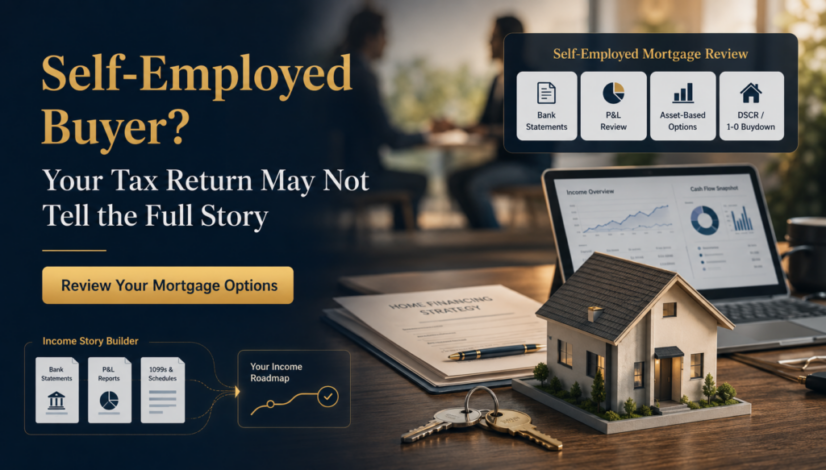
Self-Employed Mortgage Options in California: Your Tax Return May Not Tell the Full Story
Being self-employed should not automatically mean your mortgage journey has to feel impossible. But for many California business owners, freelancers, contractors, consultants, real estate investors, and 1099 earners, the mortgage process can feel frustrating.
- You may have strong income.
- You may have steady deposits.
- You may have a healthy business.
- You may have assets and reserves.
But when a traditional lender reviews your tax returns, your qualifying income may look lower than your real business strength. That is why self-employed buyers need a smarter mortgage review. At The Lending Mamba, we help self-employed Californians compare mortgage options that may fit their full financial profile.
Why Self-Employed Buyers Face Mortgage Challenges
Self-employed borrowers are different from W-2 employees. A W-2 employee usually has pay stubs, W-2 forms, and consistent payroll income. A self-employed borrower may have:
- Business income
- Personal and business bank deposits
- Tax deductions
- Profit and loss statements1099 income
- Seasonal income
- Multiple income streams
- Business expenses
- Investment property income
- Assets and reserves
Because business owners often use deductions to reduce taxable income, their tax returns may not always show the full strength of their cash flow. That does not mean they cannot qualify. It means the loan strategy may need a deeper review.
The Big Problem: Tax Returns May Not Tell the Full Story
Many self-employed buyers hear this: “Your tax return income is too low.” That can be frustrating, especially when the business is actually performing well.
The issue is that lenders need documented, stable, and qualifying income. They cannot simply use what a borrower says they earn. They must review income, assets, debts, and the borrower’s ability to repay. This is why self-employed buyers should prepare early and compare loan options before shopping for homes.
Traditional Mortgage Options for Self-Employed Borrowers
Some self-employed buyers can still qualify through traditional mortgage programs. Traditional options may include:
- Conventional loans
- FHA loans
- VA loans, if eligible
- USDA loans, if eligible
- Jumbo loans
- Refinance options
For traditional financing, lenders may review personal tax returns, business tax returns, K-1s, 1099s, profit and loss statements, balance sheets, bank statements, and business history. This path may work well if your tax returns show enough stable qualifying income.
Bank Statement Loans
Bank statement loans may be worth reviewing for some self-employed borrowers. Instead of relying only on traditional tax-return income, a bank statement loan may allow lenders to review personal or business bank deposits over a certain period. This may help business owners whose tax returns do not reflect the full strength of their cash flow. Bank statement loans may be useful for:
- Business owners
- Freelancers
- Independent contractors
- Consultants
- Real estate professionals
- 1099 earners
- Entrepreneurs with strong deposits
However, these loans may come with different pricing, down payment requirements, documentation needs, and guidelines. Buyers should compare the full terms carefully.
P&L Mortgage Loans
A profit and loss mortgage option may help some business owners show current business performance. A P&L statement can help show revenue, expenses, and net income over a recent period. This may be useful for borrowers whose current business income is stronger than what older tax returns show. A P&L loan may be worth reviewing if:
- Your business revenue has grown recently
- Your tax returns do not show your current income strength
- You have strong business records
- You can document deposits and expenses
- You want an alternative-documentation review
Asset-Based Mortgage Options
Some borrowers may have strong assets but complex income. Asset-based mortgage options may be worth reviewing if you have significant liquidity, investment accounts, retirement assets, or other acceptable assets. This can be helpful for borrowers who have wealth but do not fit traditional income documentation easily. Asset-based options may be relevant for:
- Business owners
- Investors
- Retirees
- High-net-worth borrowers
- Borrowers with complex tax structures
- Borrowers with strong reserves
DSCR Loans for Investors
Self-employed borrowers who are buying investment properties may also review DSCR loans. DSCR stands for Debt Service Coverage Ratio. Instead of focusing primarily on personal income, DSCR loans may focus more on the rental property’s income compared with the property’s payment obligations. DSCR loans may be useful for:
- Rental property investors
- Real estate investors
- Short-term rental buyers
- Borrowers with complex personal income
- Investors focused on property cash flow
DSCR loans are generally investor-focused and may not be used for every type of purchase. Terms and requirements can vary.
Common Mistakes Self-Employed Borrowers Make
Avoid these common mistakes:
- Shopping before a mortgage review
- Assuming tax returns are the only option
- Mixing personal and business funds without clarity
- Not preparing bank statements
- Not having updated profit and loss records
- Writing off too much income without understanding mortgage impact
- Opening new credit before applying
- Making large undocumented depositsAssuming all lenders review self-employed income the same way
- Waiting until escrow to solve documentation issues
Documents Self-Employed Buyers May Need
Depending on the loan type, borrowers may need:
- Personal tax returns
- Business tax returns
- 1099 forms
- K-1s
- Year-to-date profit and loss statement
- Business bank statements
- Personal bank statements
- Business license
- CPA letter, if needed
- Asset statements
- Lease agreements for rental property
- Debt schedule
- Identification and credit authorization
The Lending Mamba 1-0 Buydown Advantage
Self-employed buyers purchasing a home should also ask about The Lending Mamba’s 1-0 Buydown offer. The Lending Mamba is covering the cost of your 1-0 Buydown for eligible purchase transactions. This may help lower your payment in year one, giving you more breathing room as you settle into homeownership.
For business owners, the first year of homeownership may come with extra moving costs, business planning, tax planning, and cash flow adjustments. A temporary year-one payment strategy may be worth reviewing. A 1-0 Buydown is temporary, so borrowers should understand the standard payment after year one.
What Self-Employed Buyers Should Ask
Before choosing a mortgage, ask:
Q. Can my tax-return income qualify?
Q. Should I review bank statement options?
Q. Can a P&L loan help?
Q. Can assets support my loan file?
Q. Do I need a conventional, FHA, jumbo, or non-QM option?
Q. Am I buying a primary residence or investment property?
Q. Would DSCR fit my rental property purchase?
Q. How much down payment may be required?
Q. What documents should I prepare now?
Q. Can a 1-0 Buydown help with year-one payment comfort?
Q. What is my full monthly payment after year one?
Why Work With The Lending Mamba?
The Lending Mamba helps self-employed borrowers compare mortgage options with a strategy-first approach. We understand that business-owner income can be more complex than W-2 income. We help review documentation, loan paths, payment strategy, and lender options so borrowers can understand what may fit. We help self-employed buyers explore:
- Traditional mortgage options
- Bank statement loans
- P&L loans
- Asset-based options
- DSCR investor loans
- Jumbo options
- Refinance options
- 1-0 Buydown strategies for eligible purchases
Final Thoughts
Self-employed in California? Your tax return may not tell the full story. If you are a business owner, freelancer, 1099 earner, consultant, or investor, you may have more mortgage options than you think. Before you assume you cannot qualify, review your mortgage path with The Lending Mamba.
The Lending Mamba
Call: 657-777-0024
Visit: www.thelendingmamba.com
Disclaimer: Eligibility, rates, terms, loan options, documentation requirements, program availability, and payment changes may vary. This content is for educational purposes only and is not a commitment to lend, guarantee of approval, or financial advice.