Refinance Math in California: Check the Break-Even Point Before You Refinance
A lower refinance rate can sound exciting. You may see a headline, receive a lender email, or hear someone say, “Rates dropped — you should refinance.” But before you move forward, you need to ask one important question:
Does the refinance math actually work? Refinancing is not only about getting a lower rate. It is about comparing the full cost of the new loan against the real benefit you may receive.
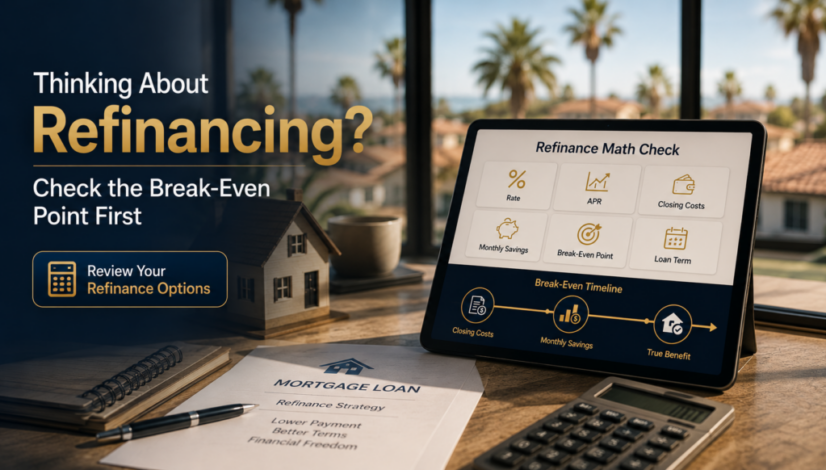
At The Lending Mamba, we help California homeowners review refinance options by looking at rate, APR, closing costs, monthly savings, loan term, equity, and break-even point before making a decision.
What Does It Mean to Refinance?
Refinancing means replacing your current mortgage with a new mortgage. Homeowners may refinance for different reasons, such as:
- Lowering the interest rate
- Reducing the monthly payment
- Changing the loan term
- Moving from an adjustable-rate mortgage to a fixed-rate mortgage
- Removing mortgage insurance, if eligible
- Accessing equity through a cash-out refinance
- Consolidating debt
- Changing loan structure
The Biggest Refinance Mistake
The biggest mistake homeowners make is looking only at the interest rate. A lower rate may reduce your monthly payment, but refinancing often comes with costs. Those costs may include:
- Lender fees
- Origination charges
- Discount points
- Appraisal fees
- Title and escrow fees
- Credit report fees
- Recording fees
- Prepaid interest
- Escrow setup
- Other closing costs
If the savings are small and the costs are high, the refinance may take too long to make financial sense. That is why the break-even point matters.
What Is the Refinance Break-Even Point?
The refinance break-even point is the amount of time it takes for your monthly savings to recover the cost of refinancing. The simple formula is:
Refinance closing costs divided by monthly payment savings equals break-even point. For example, if a homeowner pays refinance costs and receives a monthly payment reduction, the break-even point estimates how many months it may take before the savings make up for the cost.
If you plan to stay in the home longer than the break-even period, the refinance may be worth reviewing. If you plan to sell, move, or refinance again before reaching the break-even point, the refinance may not make sense.
Why Break-Even Matters in California
California homeowners often have higher loan balances than homeowners in many other states. That means even small differences in rate, APR, closing costs, or loan term can have a major impact. A refinance may look attractive at first, but California homeowners should compare:
- How much the payment changes
- How much the refinance costs
- How long it takes to recover the costs
- Whether the loan term restarts
- Whether equity is reduced
- Whether cash is being taken out
- Whether monthly savings are real or just delayed costs
- Whether the new loan fits long-term goals
Interest Rate vs APR
A refinance offer may show a low interest rate, but homeowners should also review the APR. The interest rate helps calculate the monthly principal and interest payment.
APR gives a broader picture because it can include certain loan costs. A refinance with a low interest rate but higher upfront fees may not be as strong as it first appears. This is why homeowners should compare both rate and APR before choosing.
Points and Fees Can Change the Deal
Some refinance offers include points. A point is an upfront cost paid to lower the interest rate. Paying points may make sense if you keep the loan long enough to benefit from the lower payment. But if you sell or refinance again too soon, paying points may not be worth it. Before paying points, ask:
Q. How much do the points cost?
Q. How much does the payment decrease?
Q. What is the break-even point?
Q. How long do I plan to keep this loan?
Q. Would that cash be better used elsewhere?
“No Closing Cost” Refinance: Read the Fine Print
Some refinance offers are advertised as “no closing cost.” That does not always mean the costs disappear. In many cases, closing costs may be rolled into the loan balance or offset through a higher interest rate. This may reduce upfront cash needed, but it can still affect the long-term cost. A no-closing-cost refinance may be useful in certain situations, but homeowners should ask:
Q. Are costs being added to my loan balance?
Q. Is the interest rate higher?
Q. How does this affect my monthly payment?
Q. How does this affect total interest over time?
Q. What is the real cost of this option?
Loan Term: Are You Restarting the Clock?
Another refinance mistake is ignoring the loan term. If you are several years into a 30-year mortgage and refinance into a new 30-year mortgage, your payment may go down, but the repayment timeline may restart. That can increase the total interest paid over time.
Some homeowners may prefer a shorter term, such as a 15-year loan, if they want to pay off the home faster. Others may prefer a longer term for payment flexibility. The key is to compare both monthly payment and long-term cost.
Cash-Out Refinance: Different Math
A cash-out refinance replaces your current mortgage with a larger loan and lets you access a portion of your equity as cash. This can be useful for home improvements, debt consolidation, investment planning, or other needs, but the math is different from a simple rate-and-term refinance. With a cash-out refinance, homeowners should compare:
- New loan amount
- Cash received
- Rate and APR
- Closing costs
- Monthly payment
- Total interest
- Equity remaining
- Loan term
- Alternative options such as HELOC or home equity loan
When Refinancing May Make Sense
Refinancing may be worth reviewing if:
- Your rate may improve enough to offset costs
- You plan to stay past the break-even point
- You want to change loan terms
- You want to move from ARM to fixed
- You want to remove mortgage insurance, if eligible
- You need cash-out and have a clear repayment strategy
- Your financial goals have changed
- You can reduce total interest over time
When Refinancing May Not Make Sense
Refinancing may not make sense if:
- Closing costs are too high compared with savings
- You plan to sell soon
- You may refinance again before breaking even
- The new term increases long-term cost too much
- You are only reacting to a rate headline
- You do not understand fees or points
- You are rolling too much cost into the new loan
- The payment savings are not meaningful
- You are using equity without a clear plan
What Homeowners Should Compare
Before refinancing, compare:
- Current loan balance
- Current interest rate
- Current monthly payment
- Current remaining term
- New interest rate
- New APR
- New monthly payment
- New loan term
- Closing costs
- Points
- Cash to close
- Cash-out amount, if applicable
- Break-even point
- Total interest over time
- Equity impact
- Future plans for the property
Questions to Ask Before Refinancing
Before moving forward, ask:
Q. What is my break-even point?
Q. How much will I save monthly?
Q. What are my total refinance costs?
Q. Am I paying points?
Q. Is the rate locked?
Q. What is the APR?
Q. Will my loan term restart?
Q. How much interest will I pay over time?
Q. Am I rolling costs into the loan?
Q. Is this truly no-cost or just no upfront cost?
Q. How long do I plan to keep the home?
Q. Should I compare a HELOC or home equity loan instead?
Why Work With The Lending Mamba?
The Lending Mamba helps California homeowners compare refinance options clearly. We help review:
- Rate
- APR
- Closing costs
- Monthly payment
- Break-even point
- Loan term
- Cash-out options
- Home equity alternatives
- Long-term goals
- Total cost comparison
Final Thoughts
A lower refinance rate can be exciting, but it is not the whole story. Before you refinance, check the math. Compare your rate, APR, closing costs, monthly savings, loan term, and break-even point. The Lending Mamba can help you review the full refinance picture before you decide.
The Lending Mamba
Call: 657-777-0024
Visit: www.thelendingmamba.com
Disclaimer: Eligibility, rates, terms, loan options, fees, closing costs, APR, payment savings, and program availability may vary. This content is for educational purposes only and is not a commitment to lend, financial advice, tax advice, or guarantee of savings.