
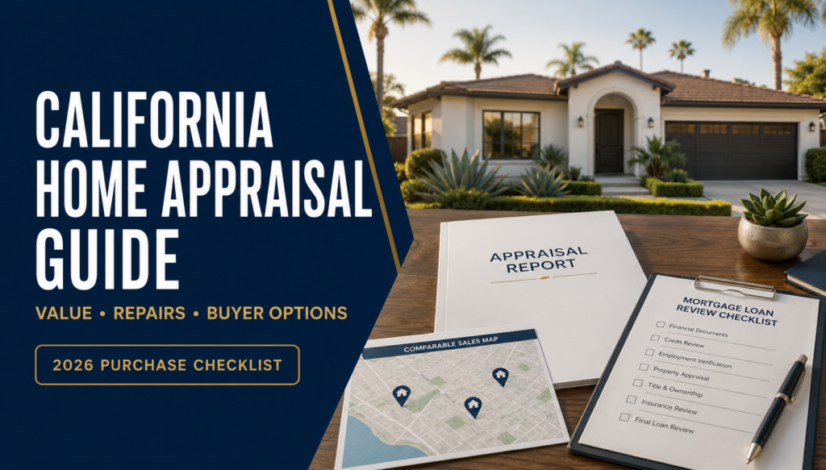
California Home Appraisal Guide 2026: Low Appraisals, Repairs and Buyer Options
A California buyer can be financially qualified, have an accepted offer and complete the home inspection—yet still face an important mortgage condition: the appraisal.
The appraisal helps the lender evaluate the property that will secure the loan. It is an independent opinion of value based on the home, comparable market data and the requirements of the assignment. Depending on the mortgage program, the appraisal may also identify property conditions that must be addressed before closing.
Most appraisals do not create a major problem. When the appraised value is below the contract price, however, the buyer may need to review the report, reconsider the financing, negotiate with the seller or use a contractual right. The answer depends on the loan program, available cash, appraisal findings and purchase agreement.
This 2026 guide explains the process in practical language so California buyers can prepare without treating an appraisal as either a formality or a reason to panic.
Quick answer: A mortgage appraisal evaluates the property for the lender; it does not approve the borrower or replace a home inspection. If the value is below the purchase price, the lender may calculate the loan using the lower value. Possible next steps can include reviewing the report for errors, requesting a reconsideration of value through the lender, renegotiating the transaction, changing the financing or contributing additional eligible funds.
What Is a Home Appraisal?
A home appraisal is a professional opinion of a property’s market value as of a stated effective date. The lender uses the valuation to help determine whether the property provides acceptable collateral for the requested mortgage.
The appraiser may analyze:
- Property location and neighborhood characteristics
- Site size and utility
- Living area and room count
- Property type and design
- Age, quality and condition
- Improvements, remodeling and additional features
- Accessory structures or accessory dwelling units
- Recent comparable sales
- Current listings or pending sales when relevant
- Market conditions
- Sales concessions or other transaction information
- Visible conditions that may affect safety, soundness or marketability
The appraisal does not guarantee the home’s future value. It also does not promise that every system works or that no hidden defect exists.
Why Does the Lender Need an Appraisal?
The mortgage is secured by the property. The lender therefore needs an acceptable method of establishing value and confirming that the home meets the selected program’s collateral requirements.
The appraisal may influence:
- The value used to calculate the loan-to-value ratio
- The maximum loan amount available under the structure
- Mortgage-insurance requirements
- Whether repairs or further inspections are required
- Whether a unique property is acceptable to the program
- Final underwriting and closing conditions
For a conventional purchase loan delivered to Fannie Mae, the current loan-to-value guidance generally calculates property value using the lower of the sales price or current appraised value. Other programs have their own requirements, but the same practical issue appears frequently: paying more than the appraised value does not automatically increase the lender’s collateral value.
Who Orders and Chooses the Appraiser?
The lender or its authorized appraisal-management process orders the appraisal. Independence rules are intended to protect the appraiser’s judgment from improper influence.
The buyer, seller, real estate agent and loan officer may provide accurate, relevant information through permitted channels, but they cannot direct the appraiser to reach a particular value.
An appraisal fee does not purchase a desired result. It pays for the valuation assignment and report.
If the report contains a factual error or misses relevant market information, the borrower can ask the lender about its reconsideration-of-value process. That is different from pressuring an appraiser to “hit the number.”
When Does the Appraisal Happen?
A typical purchase sequence may look like this:
- The buyer and seller sign the purchase agreement.
- The borrower completes the mortgage application and required disclosures.
- The lender orders the appropriate valuation.
- The appraiser schedules access when an interior inspection is required.
- The appraiser researches the property and market data.
- The completed report is delivered to the lender.
- The lender reviews the report for value, quality, eligibility and conditions.
- The borrower receives a copy.
- Repairs, corrections, reconsideration or other follow-up is completed when necessary.
- The lender finishes its collateral and underwriting review.
Timing varies by property, location, program, appraiser availability and the complexity of the assignment. A rural, luxury, multi-unit, unique, newly built or heavily renovated property may require additional research.
Do Buyers Have a Right to the Appraisal Report?
For a first-lien mortgage, the borrower generally has the right to receive a free copy of appraisals and other written valuations developed for the application.
The Consumer Financial Protection Bureau explains that the copy must be provided promptly after completion or no later than three business days before closing, whichever is earlier, under the applicable federal rule.
Read the report rather than looking only at the final value. Check the subject property details, photographs, condition, comparable sales, adjustments and any “subject to” requirements.
Appraisal Versus Home Inspection
These are different services with different purposes.
The appraisal
The appraisal is primarily a valuation and collateral review for the mortgage. The appraiser observes the property to the extent required for the assignment and loan program, but does not perform the same detailed systems review as a home inspector.
The home inspection
A home inspector evaluates the property for the buyer and may examine the roof, foundation, plumbing, electrical components, heating or cooling systems, appliances and other visible conditions. The scope depends on the inspection agreement and applicable standards.
A home can appraise at the purchase price and still have expensive defects. A home can also be well maintained yet appraise below the agreed price because market data does not support that price.
Do not waive or skip an independent inspection merely because the lender ordered an appraisal.
How Does an Appraiser Select Comparable Sales?
Comparable sales—often called “comps”—help show how buyers have recently responded to similar properties in the market.
Fannie Mae’s current comparable-sales guidance says comparable properties should have similar physical and legal characteristics and appeal to the same market participants. They do not have to be identical.
The analysis may consider differences in:
- Location
- Site size or view
- Living area
- Room and bedroom count
- Design and property type
- Age and condition
- Quality of construction
- Garage, pool or other features
- Accessory dwelling unit
- Renovations and updates
- Sale date and market conditions
- Financing or seller concessions
For the sales-comparison approach in a Fannie Mae appraisal, a minimum of three closed comparable sales is generally reported. Additional sales, listings or pending transactions may be included when they help support the analysis.
The nearest sale is not always the best comparable. A recent home across the street may have a different view, size, condition, lot, legal use or construction quality. Conversely, a property farther away may compete more directly with the subject home.
Why Are Appraisal Adjustments Different From Remodeling Costs?
An appraisal adjustment reflects how the market responds to a difference between the subject property and a comparable sale. It is not simply the cost of installing the feature.
For example:
- A remodeled kitchen may cost more than the value buyers assign to it.
- A pool may have different market appeal by location and property type.
- An extra bedroom may contribute less value if it creates an awkward layout.
- Solar panels may be treated differently depending on ownership and market evidence.
- An accessory unit may contribute value only to the extent supported by its legal characteristics, utility and comparable data.
Online remodeling calculators and listing prices are not substitutes for market-supported appraisal analysis.
Purchase Price, Market Value and Appraised Value
These numbers can be different.
Purchase price is the amount the buyer and seller agree to in the contract.
Market value is an opinion of what a typical buyer would pay under the definition and conditions used in the appraisal assignment.
Appraised value is the appraiser’s supported opinion as stated in the report.
In a competitive market, a buyer may intentionally offer above recent comparable sales. That can win the contract, but it does not guarantee that the appraisal will match the offer. The mortgage file must be evaluated using the applicable loan rules.
What Is an Appraisal Gap?
An appraisal gap is the difference between the purchase price and appraised value when the appraisal is lower.
The amount of additional cash a buyer may need is not always equal to the simple difference. It depends on how the lower value changes the permitted loan amount, down payment, mortgage insurance, reserves and program requirements.
Before committing to cover a gap, ask the lender for a revised calculation showing:
- Maximum eligible loan amount
- Revised down payment
- Cash required to close
- Mortgage-insurance impact
- Reserve requirements
- Whether gift funds or other sources are permitted
- Whether the borrower still qualifies
Do not transfer additional funds or modify the agreement based only on a verbal estimate.
What Happens When the Appraisal Is Lower Than the Purchase Price?
A low appraisal does not produce one automatic outcome. The buyer’s options depend on the purchase contract, mortgage program, financial qualification and willingness of both parties to negotiate.
Option 1: Review the report carefully
Look for objective issues such as:
- Incorrect address, parcel or property type
- Wrong living area, room count or site size
- Missing permitted improvements
- Incorrect condition or quality description
- A sale that was not actually comparable
- A relevant recent sale that may have been overlooked
- Failure to account for a material location difference
- Incorrect information about a concession or prior transaction
Disagreeing with the value is not enough. A useful review identifies specific facts and credible market evidence.
Option 2: Request a reconsideration of value
A reconsideration of value, or ROV, asks the lender to review relevant information and determine whether it should be sent to the appraiser for further analysis.
Fannie Mae requires lenders to maintain a borrower-initiated ROV process for loans requiring an appraisal. Its current Appraisal Quality Matters guidance calls for a review and resolution procedure when the borrower believes the value conclusion is unsupported because of deficiencies or relevant information.
The CFPB’s June 2026 consumer guidance on challenging inaccurate appraisals explains that an ROV can address factual or procedural errors, relevant comparable sales and concerns that prohibited bias influenced the valuation.
An ROV does not guarantee a higher value. The appraiser may revise the report, explain why no change is supported or correct an issue without changing the final opinion.
Option 3: Renegotiate the purchase price
The buyer may ask the seller to reduce the price. The seller may agree, decline or propose a different adjustment.
A lower price can reduce or eliminate the appraisal gap, but it does not automatically solve every loan issue. The lender must review the amended contract and update the transaction.
Option 4: Increase the buyer’s cash contribution
If permitted by the contract and loan program, an eligible buyer may choose to contribute more cash. The lender must verify the source of funds and confirm that required reserves and qualification remain acceptable.
Do not drain emergency savings simply to preserve the transaction. Compare the additional cash with the home’s condition, future expenses and the reason the appraisal was low.
Option 5: Change the financing structure
A different down-payment level or loan program may change the calculation, but it does not make the collateral value disappear. New underwriting, mortgage-insurance, appraisal or timing requirements may apply.
Ask for a written side-by-side comparison before changing programs late in escrow.
Option 6: Use a contractual right when available
The purchase agreement may provide an appraisal contingency or another remedy. The availability and deadline depend on the actual contract and any waivers or addenda.
Buyers should consult their real estate and legal professionals before cancelling, waiving a protection or releasing a deposit. A mortgage professional does not interpret the purchase agreement.
What Makes a Strong Reconsideration-of-Value Request?
A strong request is factual, concise and relevant to the appraisal’s effective date.
It may include:
- A clear description of each suspected error
- Supporting public records or approved plans
- A short explanation of why a proposed comparable competes with the subject
- The sale date and verified terms of the comparable
- Relevant information about renovations or permitted additions
- Market evidence available as of the appraisal’s effective date
- A concern about unsupported language or possible prohibited bias
Avoid:
- Demanding a particular value
- Sending a long list of higher-priced but dissimilar homes
- Using listings as though they were closed sales
- Relying on online estimates without market support
- Contacting or pressuring the appraiser directly
- Submitting information that occurred after the effective date without explaining its relevance
The lender controls the ROV process and communicates with the appraiser through the permitted channel.
Can the Buyer Order a Second Appraisal?
Not simply because the first value was disappointing.
A lender may obtain a new appraisal or review when allowed and supported by its policies, program rules or material concerns about the first report. It cannot use repeated appraisals as a way to shop for a desired value.
Changing lenders may create a new appraisal requirement, but that introduces new cost, timing and underwriting risk. A second report can reach the same or a lower value. Do not assume that restarting the loan is a reliable appraisal-gap strategy.
What Does “Subject To” Mean in an Appraisal?
An appraisal may value the property:
- As is
- Subject to completion of repairs or alterations
- Subject to completion according to plans and specifications
- Subject to another condition described in the report
When the appraisal is “subject to” required work, the lender may require completion and acceptable verification before closing. A final inspection or completion certification may be needed.
Fannie Mae’s current property-condition guidance states that physical deficiencies affecting safety, soundness or structural integrity must be identified and can require the property to be appraised subject to repairs.
The buyer and seller should confirm:
- Which repairs are required by the lender or program
- Who will complete and pay for them
- Whether permits are needed
- How access and inspections will be coordinated
- Which professional must verify completion
- What happens if the work cannot be completed by closing
A casual repair receipt may not satisfy the lender if a licensed report, permit, reinspection or appraisal-completion form is required.
Conventional, FHA and VA Appraisals Are Not Identical
Conventional loans
The lender evaluates the appraisal under the applicable conventional program and its own underwriting standards. Property-condition concerns affecting safety, soundness, structural integrity or marketability can require follow-up.
FHA loans
An FHA appraisal addresses value and applicable FHA property requirements. HUD’s Single Family Housing Policy Handbook 4000.1 is the current official source for FHA appraisal and property policy.
An FHA appraisal is still not a substitute for an independent home inspection. Items that do not create an FHA repair condition can remain important to the buyer.
VA loans
VA uses an appraisal and Notice of Value process with VA Minimum Property Requirements. Its 2026 appraisal resources also address reconsiderations of value and valuation review.
The VA Escape Clause guidance, updated in January 2026, explains the buyer protections that may apply when the negotiated price exceeds VA’s reasonable value. The exact contract and loan must be reviewed by the appropriate professionals.
Program requirements change. Ask the lender which appraisal and property rules apply before assuming that a repair or valuation result will be identical across loan types.
Can a Loan Close Without a Traditional Appraisal?
Some eligible conventional transactions may receive an automated valuation option such as Fannie Mae value acceptance. This is determined through the lender’s underwriting system based on the loan case file and available property data.
Value acceptance is not guaranteed, and the borrower or seller cannot demand it. A traditional appraisal may still be required if transaction details change, eligibility conditions are not met or the lender determines that further valuation is necessary.
Even when no traditional appraisal is required, the buyer should still complete appropriate property investigations and inspections.
Special California Property Issues That May Affect the Appraisal
Accessory dwelling units
The report should accurately describe an ADU and analyze its market contribution. Permit status, living facilities, site utility, rental information and comparable properties may matter. See The Lending Mamba’s California ADU Financing Guide for broader financing preparation.
Solar panels
Owned, financed and leased systems may be treated differently. Provide the lender with the complete agreement and ownership information early.
Unpermitted additions or conversions
A garage conversion, enclosed patio or added living area may not receive the treatment a seller expects. Local records, quality, safety, legal use and market acceptance can affect the analysis and loan eligibility.
Rural or unique properties
There may be fewer similar sales, requiring the appraiser to expand the search area or use older comparables with explanation. That does not automatically make the report unreliable.
New construction
The appraisal may be based on plans and specifications and completed subject to construction. Builder sales, upgrades, incentives and outside-project comparables may need careful analysis.
Condominiums and planned developments
The unit’s value and the project’s mortgage eligibility are separate questions. A unit can appraise at the contract price while an HOA insurance, financial or project issue still affects approval. Review the California Condo Mortgage Guide for those additional requirements.
Preparing a Home for the Appraisal
The seller or listing representative can help the process by providing accurate, organized information without attempting to influence the value.
Useful items may include:
- Access instructions
- List of permitted improvements and approximate completion dates
- Approved plans or permits for additions
- Solar ownership documents
- ADU records
- Survey or relevant property documents
- Information about significant repairs
- A list of recent relevant sales for the appraiser’s independent consideration
Basic access matters. The appraiser may need to observe each required area, including rooms, garage, attic or crawlspace access when applicable to the assignment. Pets, locked gates and missing keys can create delays.
Cosmetic staging may improve presentation but does not convert décor into market value. Accurate condition and documented improvements are more useful than fresh flowers or expensive furniture.
A Buyer’s Appraisal Review Checklist
When the report arrives, review:
Subject property
- Correct address and parcel information
- Property type and legal description
- Site size
- Living area
- Room, bedroom and bathroom counts
- Garage and accessory structures
- ADU or permitted addition details
- Quality and condition ratings
- Listed repairs or deficiencies
Comparable sales
- Sale dates
- Locations and distances
- Property type
- Living area and site size
- Condition and quality
- Major adjustments
- Concessions or unusual sale terms
- Appraiser’s explanation for selection
Final reconciliation
- Final opinion of value
- Effective date
- “As is” or “subject to” status
- Required repairs or inspections
- Assumptions and limiting conditions
- Lender review notes or additional conditions
Ask the lender for clarification when a term is unclear. Do not contact the appraiser directly about changing the value.
Notes for Corona and Anaheim Buyers
Corona and Anaheim contain a wide range of homes, including older properties, hillside homes, planned developments, condominiums, newer subdivisions, properties with solar systems and homes with conversions or ADUs.
The best comparable sale is determined by the property and market—not merely by the city name or ZIP Code. A sale on the other side of a freeway, in a different school area, within another planned community or with a different view may compete differently in the market.
Before making an aggressive offer, ask the real estate professional for recent closed sales that genuinely resemble the property. Then ask the mortgage professional how the financing would change if the appraisal were below the purchase price.
This does not predict the appraisal. It gives the buyer a plan before an unexpected result arrives.
Common Appraisal Mistakes Buyers Should Avoid
Treating the appraisal as an inspection
The appraisal serves the lender’s valuation and collateral needs. Obtain a separate inspection for the buyer’s property review.
Assuming the contract price guarantees the value
An accepted offer shows what one buyer agreed to pay. The appraiser must analyze broader market evidence under the assignment requirements.
Comparing only price per square foot
Value can be affected by location, lot, condition, quality, design, view, utility and concessions. One calculation cannot replace the complete analysis.
Sending irrelevant “comps”
A higher sale is not helpful if it is not competitive with the subject property. Explain similarities and material differences.
Contacting the appraiser to argue the value
Use the lender’s formal ROV process. Appraisal independence must be protected.
Assuming an ROV guarantees a change
An ROV is a review mechanism, not a second negotiation. The value changes only when supported by credible information.
Committing all available cash to an appraisal gap
Preserve funds for closing, repairs, moving and household reserves. Ask the lender for a revised calculation before deciding.
Ignoring contractual deadlines
Appraisal contingency dates and notice requirements can be time-sensitive. Discuss them with the buyer’s real estate and legal professionals.
Frequently Asked Questions
Q1. Who pays for the home appraisal?
A. The borrower commonly pays the appraisal fee as part of the mortgage process, although transaction arrangements vary. Paying the fee does not allow the borrower to select the value.
Q2. How long does a California appraisal take?
A. Timing depends on property access, location, appraiser availability, report complexity and lender review. Unique, rural, luxury or multi-unit properties may require more research.
Q3. Does the appraiser know the purchase price?
A. For a purchase appraisal, the appraiser generally reviews the sales contract and transaction information. The contract price is considered, but it does not dictate the final opinion of value.
Q4. What happens if the appraisal equals the purchase price?
A. The lender continues its review. A supported value does not remove other conditions involving the borrower, title, insurance, property eligibility, repairs or documentation.
Q5. What happens if the appraisal is higher than the purchase price?
A. The buyer normally pays the agreed contract price unless the parties lawfully amend the agreement. A higher appraisal does not automatically become cash available to the buyer or change the loan amount.
Q6. What happens if the appraisal is lower than the purchase price?
A. The lender may base the financing on the lower value. The parties may review the report, request an ROV, renegotiate, change financing, contribute eligible additional funds or use a contractual right when available.
Q7. Can the seller challenge a low appraisal?
A. The borrower generally makes the ROV request through the lender. The seller or agents may provide relevant information to the borrower and lender through permitted channels.
Q8. Can I give the appraiser my own comparable sales?
A. Relevant information may be provided through an acceptable process, often before the report is completed. The appraiser independently decides which sales are appropriate and how they affect the analysis.
Q9. Can repairs increase the appraised value?
A. Repairs may remove a property condition or support a different completed condition, but the value effect must be supported by the appraisal and market. Repair cost does not automatically equal added value.
Q10. Is an FHA appraisal stricter than a conventional appraisal?
A. The programs have different property and documentation requirements. “Stricter” is too broad; the result depends on the property condition and applicable rule. Neither appraisal replaces a home inspection.
Q11. Can I switch lenders after a low appraisal?
A. It may be possible, but switching can create new appraisal, cost, timing and underwriting requirements. A new lender does not guarantee a different value.
Q12. Can an appraisal be biased or inaccurate?
A. Appraisals must comply with applicable laws and professional standards, but errors or prohibited bias can occur. Review the report and use the lender’s ROV process to identify factual issues, relevant evidence or concerns about discriminatory treatment.
Prepare for the Appraisal Before It Becomes a Problem
An appraisal is easier to manage when the buyer understands the process before making the offer. Review comparable sales, keep enough reserves, understand the contract’s appraisal provisions and ask the lender how the financing changes at a lower value.
The Lending Mamba can help California buyers understand how an appraised value may affect the proposed loan structure, down payment, mortgage insurance and closing plan.
Call: 657-777-0024 or 844-24-MAMBA
Email: Info@thelendingmamba.com
Office: 5101 E La Palma Ave, Suite 204, Anaheim, CA 92807
Website: TheLendingMamba.com
Start a conversation: Contact The Lending Mamba