
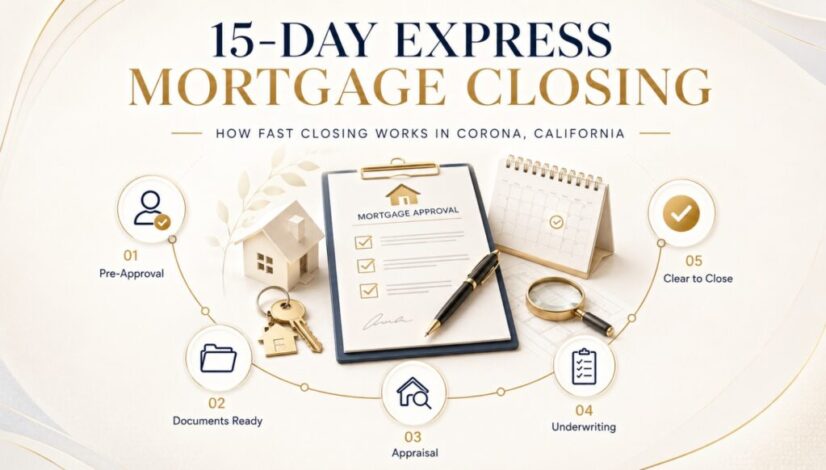
15-Day Express Mortgage Closing in Corona, California – How It Works
A fast mortgage closing can make a big difference in a competitive housing market. For buyers in Corona, California, a 15-day express mortgage closing can be especially attractive when sellers want speed, buyers want stronger offers, or a move needs to happen quickly.
But a fast closing is not just about moving faster at the end. It depends on preparation from the very beginning.
At The Lending Mamba, we help buyers understand what a fast mortgage closing really involves, what needs to happen on time, and what can slow the process down.
What Does “15-Day Express Mortgage Closing” Mean?
A 15-day express mortgage closing generally means a lender and borrower are aiming to move from accepted contract to closing in about 15 days. This is much faster than a traditional timeline.
That said, a fast close is not automatically available for every borrower or every property. It usually works best when the borrower is well prepared, the file is clean, the lender moves quickly, and all third parties stay on schedule.
In other words, fast closing is possible — but it is a coordinated process, not a shortcut.
The Mortgage Process Still Follows Key Federal Timing Rules
Even when a mortgage is moving quickly, lenders still follow federal disclosure timing rules. The CFPB says that once you submit the six key pieces of information for a mortgage application, each lender is required to send you a Loan Estimate within three business days. The CFPB also says you must receive the Closing Disclosure at least three business days before closing.
That means an express close still has structure. A fast lender is not skipping steps — it is making sure those steps happen efficiently and on time.
Why Fast Closings Matter in Corona, California
In a local market like Corona, a shorter closing timeline can help buyers in several ways:
- It may make an offer more attractive to a seller
- It can reduce the waiting period between contract and move-in
- It may help buyers with relocation timelines
- It can reduce some transaction uncertainty
- It may help buyers compete against slower offers
For sellers, speed often signals confidence and organization. For buyers, speed can reduce stress — if the file is handled correctly.
Step 1: Get Fully Prepared Before You Go Under Contract
The biggest secret behind a fast closing is preparation before the offer is accepted.
That means reviewing income, assets, credit, debts, and loan structure early. It also means gathering your documents before the lender has to chase them.
A strong express-close borrower is usually already prepared with:
- ID
- Pay stubs
- W-2s
- Bank statements
- tax returns if needed
- asset statements
- proof of employment
- down payment documentation
- insurance information when needed
The more complete the file is at the beginning, the easier it is to move quickly.
Step 2: Application and Loan Estimate
After application, the lender issues the Loan Estimate. The CFPB says the Loan Estimate must generally be provided within three business days after the lender receives the application information required by law.
In a fast-closing strategy, this step should happen quickly and accurately. If the application details are incomplete or the borrower delays responses, the timeline can immediately slip.
Step 3: Intent to Proceed and Immediate Document Submission
Once the Loan Estimate is reviewed, the borrower typically needs to confirm they want to move forward and provide all requested supporting documents right away.
This is where many transactions lose speed. A fast-closing file cannot sit still for two or three days waiting on missing statements, unsigned disclosures, or unclear deposits.
Fast closings happen when buyers respond fast too.
Step 4: Processing, Verification, and Appraisal Ordering
Once the lender has the core documents, processing begins. Income, assets, credit, and employment are reviewed. The appraisal is often ordered right away. Title and escrow are also moving in parallel.
A 15-day closing depends heavily on these parts happening simultaneously, not one after another. That includes lender work, appraisal coordination, title work, escrow communication, and borrower responsiveness. That is an inference based on the CFPB’s description of the closing process, which includes lender funding, settlement or escrow coordination, required documents, insurance, and recording before ownership transfer occurs.
Step 5: Underwriting and Conditions
Underwriting is where the lender reviews the file in detail and decides whether the loan can move forward, often with conditions that still need to be satisfied.
Common conditions may include:
- updated bank statements
- clarification of deposits
- homeowner’s insurance
- appraisal-related items
- title conditions
- employment verification
- signed letters of explanation
The faster these conditions are satisfied, the faster the file can move to final approval.
Step 6: Closing Disclosure and Final Review
The CFPB states that the Closing Disclosure is a five-page form with the final terms, monthly payments, fees, and other closing costs, and that the lender must provide it at least three business days before closing.
This is a major checkpoint in an express closing. Buyers should review it carefully and compare it with the Loan Estimate. If errors are found late, the closing timeline can be affected.
Step 7: Signing, Funding, and Recording
The CFPB explains that before closing, borrowers receive and sign many documents, funds are transferred, homeowners insurance must be in place for lender funding, and once documents are signed, funds are disbursed, and the closing is finalized, the transfer of ownership is completed and recorded with the county office.
For a 15-day close, this final stage still has to happen correctly. Speed is useful, but accuracy matters just as much.
Why Local Mortgage Guidance Helps
A fast close requires strong communication between the borrower, lender, real estate agent, escrow, title, and sometimes the appraiser and insurance provider.
Working with a team that understands California transactions and local expectations can help keep the timeline organized. In a place like Corona, where buyers may be competing on both price and terms, timing can be a real advantage.
How The Lending Mamba Helps
At The Lending Mamba, we help Corona buyers review whether a fast mortgage closing is realistic for their file. We work to create clarity early, identify document needs upfront, and keep communication moving throughout the process.
Our goal is not just to promise speed. It is to help borrowers close with both speed and confidence.
Final Thoughts
A 15-day express mortgage closing in Corona, California can be a strong advantage in the right situation. But it works best when the borrower is fully prepared, the lender is proactive, and every step moves quickly without losing accuracy.
Fast closings are not about skipping the process. They are about managing the process well.
Contact The Lending Mamba today.
www.thelendingmamba.com
657-777-0024
Disclaimer: Mortgage timelines, approvals, appraisals, funding speed, rates, costs, and eligibility can vary by borrower, property, loan program, and lender requirements. This article is for educational purposes only and is not a guarantee of closing time, approval, or loan terms.