Mortgage Options for Self-Employed Californians – P&L, Asset-Based, and DSCR Loans
Self-employed Californians often face a mortgage challenge that W-2 employees do not. A business owner may have strong cash flow, solid assets, and excellent financial discipline — but tax returns may not show income in the same simple way as a pay stub.
That does not always mean home financing is out of reach. It means the borrower may need the right mortgage strategy.
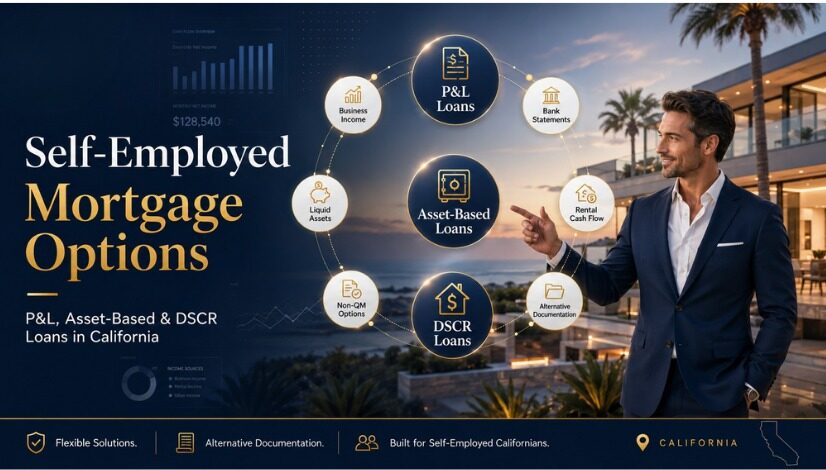
Mortgage options for self-employed Californians may include traditional tax-return loans, Profit & Loss mortgage loans, bank statement loans, asset-based loans, asset utilization loans, and DSCR loans for investment properties.
At The Lending Mamba, we help self-employed borrowers compare mortgage paths that may better reflect their full financial picture.
Why Self-Employed Borrowers Face Mortgage Challenges
Traditional mortgage underwriting often focuses on stable, documented income. For W-2 employees, that may mean pay stubs, W-2s, and employment verification.
For self-employed borrowers, income can be more complex. Business owners may have deductions, seasonal revenue, multiple entities, partnership income, contractor income, retained earnings, or fluctuating monthly deposits.
Fannie Mae’s Selling Guide has a dedicated self-employment income section, and its self-employment documentation guidance notes that lenders generally use a history of prior earnings to help demonstrate the likelihood that income will continue.
This is why self-employed mortgage planning should start early.
What Lenders Usually Review
Mortgage lenders may review:
- Personal tax returns
- Business tax returns
- Profit and loss statements
- Bank statements
- Business ownership percentage
- Credit score
- Debt obligations
- Assets and reserves
- Down payment
- Property type
- Occupancy
- Loan-to-value ratio
- Ability to repay
The CFPB explains that under the Ability-to-Repay rule, lenders generally must find out, consider, and document a borrower’s income, assets, employment, credit history, and monthly expenses.
Alternative documentation does not mean no documentation. It means the documentation may be different.
Option 1: Traditional Tax-Return Mortgage
Some self-employed borrowers qualify through a traditional mortgage using personal and business tax returns.
This may work well if your tax returns show enough qualifying income, your debts are manageable, your credit is strong, and you meet the loan program requirements.
Traditional options may include conventional, FHA, VA, jumbo, or high-balance loans depending on eligibility.
The benefit is that traditional loans may offer competitive pricing. The challenge is that tax deductions can reduce qualifying income.
Option 2: P&L Mortgage Loans
A Profit & Loss mortgage loan, often called a P&L mortgage loan, may help eligible business owners use a profit and loss statement as part of the income review.
This can be useful when current business performance is strong but tax returns do not fully reflect today’s income.
A P&L loan may require:
- CPA-prepared or borrower-prepared P&L, depending on lender
- Business bank statements
- Proof of business ownership
- Business license
- Personal bank statements
- Asset statements
- Credit review
- Property documentation
Many P&L mortgage options are offered through non-QM or specialty lenders.
Option 3: Bank Statement Loans
A bank statement loan may help self-employed borrowers qualify based on deposits shown in personal or business bank statements instead of traditional tax-return income.
This option may work well for borrowers who have consistent deposits and organized business accounts.
Lenders may review 12 or 24 months of statements, calculate average deposits, apply an expense factor, and determine qualifying income based on program rules.
Bank statement loans can be helpful, but borrowers should compare rates, APR, down payment, reserves, and fees carefully.
Option 4: Asset-Based Mortgage Loans
An asset-based mortgage may help borrowers qualify using eligible assets such as checking, savings, brokerage accounts, retirement accounts, or investment portfolios.
This may be useful for self-employed borrowers with strong liquidity but limited traditional income on paper.
Asset-based lending may also be called asset depletion, asset utilization, or asset qualifier lending depending on the program.
The key question is how the lender calculates and discounts eligible assets.
Option 5: Asset Utilization Loans
Asset utilization loans are often designed for borrowers whose assets tell a stronger story than income documents. The lender may calculate qualifying income from eligible assets or use assets as part of a broader repayment analysis.
This may help:
- Business owners with strong savings
- Investors with large portfolios
- Retirees with retirement accounts
- High-net-worth borrowers
- Borrowers between income phases
Fannie Mae’s general income guidance states that borrowers must be qualified with income the lender can reasonably expect to continue and that the lender must evaluate continuance based on the nature of the income and supporting documentation.
For many asset-based strategies, the “supporting documentation” is the asset profile rather than a simple paycheck.
Option 6: DSCR Loans for Investment Properties
A DSCR loan may help self-employed real estate investors finance rental properties. DSCR stands for Debt Service Coverage Ratio.
J.P. Morgan describes DSCR as a metric for assessing a borrower’s ability to cover debt obligations, and in real estate, it can measure how easily the income a property generates can cover its mortgage.
For a DSCR investment property loan, the lender may focus more on the rental property’s cash flow than the borrower’s traditional personal income.
This can be useful for self-employed investors who want to grow a rental portfolio.
P&L vs. Bank Statement vs. Asset-Based vs. DSCR
Each option solves a different problem.
P&L loans may fit business owners whose current profit and loss statement better reflects income.
Bank statement loans may fit borrowers with strong deposits.
Asset-based loans may fit borrowers with strong liquidity or investment accounts.
DSCR loans may fit investors buying or refinancing rental properties.
The right choice depends on whether the strongest part of the file is business income, deposits, assets, or property cash flow.
Are These Loans Non-QM?
Many P&L, bank statement, asset-based, and DSCR loans are considered non-QM. Non-QM loans are designed for borrowers who may not fit standard Qualified Mortgage guidelines but still have a reasonable ability to repay.
The CFPB’s Ability-to-Repay/Qualified Mortgage rule requires creditors to make a reasonable, good-faith determination that a consumer can repay a residential mortgage according to its terms.
Non-QM does not mean careless lending. It means different guidelines and documentation may apply.
Benefits for Self-Employed Borrowers
Alternative mortgage options may offer:
- More flexible documentation
- Better fit for business owners
- Options when tax returns show lower income
- Support for investors and rental property buyers
- Asset-based qualification possibilities
- Mortgage paths beyond W-2 income
For eligible borrowers, these options may open doors that traditional underwriting may close.
Trade-Offs to Consider
Self-employed mortgage options can also involve trade-offs.
Some alternative documentation loans may have higher rates, larger down payments, stronger reserve requirements, different fees, or prepayment penalties.
Borrowers should compare:
- Rate
- APR
- Closing costs
- Down payment
- Reserves
- Documentation requirements
- Loan term
- Prepayment penalty
- Long-term payment comfort
Approval is important, but the loan still needs to make financial sense.
Common Mistakes Self-Employed Borrowers Make
Avoid these mistakes:
- Waiting until the last minute to organize documents
- Assuming tax returns are the only option
- Mixing personal and business funds without clear records
- Moving large deposits without documentation
- Opening new credit before closing
- Choosing a loan only because it approves faster
- Ignoring APR and total cost
- Not comparing multiple loan structures
- Using all cash without keeping reserves
A strong self-employed loan file starts with clean documentation.
How to Prepare Before Applying
Self-employed Californians should prepare early by organizing:
- Personal tax returns
- Business tax returns
- Year-to-date P&L
- Business bank statements
- Personal bank statements
- Asset statements
- Business license
- Entity documents
- CPA contact, if applicable
- Rental income documents, if investing
- Debt schedule, if needed
The more organized the file, the easier it is to compare options.
Questions to Ask a Mortgage Professional
Ask these questions before choosing a self-employed mortgage option:
- Which documentation path fits my profile best?
- Can I qualify using tax returns?
- Would P&L or bank statement documentation help?
- Can assets be used to support qualification?
- Is DSCR better for my rental property?
- What are the rate and APR?
- What down payment is required?
- Are reserves required?
- Are there prepayment penalties?
- What could delay underwriting?
A good mortgage advisor should compare options clearly.
How The Lending Mamba Helps
At The Lending Mamba, we understand that self-employed borrowers do not always fit a standard mortgage checklist.
We work with a variety of lenders, including lenders that may offer conventional, FHA, jumbo, P&L, bank statement, asset-based, asset utilization, DSCR, and other non-QM options.
Our goal is to help you compare mortgage paths based on your real financial picture — not just one form or one number.
Whether you are a business owner, independent contractor, freelancer, investor, or high-net-worth borrower, our team can help you review your options.
Final Thoughts
Self-employed Californians may have more mortgage options than they realize. Traditional tax-return loans may work for some borrowers, while P&L, bank statement, asset-based, asset utilization, and DSCR loans may help others.
The best option depends on your income structure, assets, property type, goals, and documentation.
Contact The Lending Mamba today.
www.thelendingmamba.com
657-777-0024
Disclaimer: Loan programs, rates, APR, documentation requirements, down payment rules, reserves, prepayment penalties, and eligibility can change. This article is for educational purposes only and is not a rate quote, approval guarantee, tax advice, financial advice, or commitment to lend. Speak with a licensed mortgage professional for guidance based on your specific situation.