Self-Employed in California? Mortgage Options Beyond Traditional W-2 Income
Being self-employed can be rewarding, but it can also make the mortgage process feel more complicated. Many business owners, freelancers, contractors, real estate investors, consultants, and entrepreneurs have strong income, strong assets, and responsible financial habits. But their tax returns may not show income in the same simple way as a W-2 employee.
That does not always mean homeownership is out of reach. It means you may need the right mortgage strategy. At The Lending Mamba, we help self-employed Californians compare mortgage options that may better reflect their full financial picture.
Why Self-Employed Borrowers Face Mortgage Challenges
Traditional mortgage guidelines often look for stable and documented income. For W-2 employees, that may be straightforward. They usually provide pay stubs, W-2 forms, and employment verification. For self-employed borrowers, income can be more layered. A business owner may have:
- Business deductions
- Seasonal income
- Multiple income streams
- Partnership income
- 1099 income
- Retained business earnings
- Business bank deposits
- Profit and loss statements
- Investment income
- Rental income
- Assets that support qualification
Traditional Mortgage Options
Some self-employed borrowers can still qualify for traditional mortgage options. This may include:
- Conventional loans
- FHA loans
- Jumbo loans
- VA loans, if eligible
- USDA loans, if eligible
Traditional loan approval usually depends on tax returns, business history, income stability, credit, assets, debt-to-income ratio, and property type. This path may work well when tax returns show enough qualifying income. However, if tax deductions reduce taxable income, the borrower may qualify for less than expected. That is when alternative documentation options may be worth reviewing.
P&L Mortgage Loans
A P&L mortgage loan may help certain self-employed borrowers use a profit and loss statement as part of the income review. This may be useful when current business performance is stronger than what older tax returns show. A P&L review may include:
- Year-to-date profit and loss statement
- Business bank statements
- Business license
- Proof of business ownership
- CPA-prepared documents, if required
- Personal and business asset statements
- Credit review
- Property and loan program review
Bank Statement Loans
Bank statement loans may help self-employed borrowers qualify using personal or business bank statements instead of relying only on tax returns. This may be useful for borrowers whose cash flow is strong but whose taxable income is lower due to business deductions. A bank statement mortgage review may look at:
- Personal bank statements
- Business bank statements
- Deposit history
- Average monthly deposits
- Expense factors
- Business ownership
- Credit profile
- Assets and reserves
- Down payment
- Property type
Bank statement loans are often considered non-QM or alternative documentation loan options. They may have different pricing, down payment, reserve, and documentation requirements than standard conventional loans.
Asset-Based Mortgage Options
Some borrowers have strong assets but less traditional income documentation. Asset-based mortgage options may help eligible borrowers use assets as part of the qualification strategy. Assets may include:
- Checking accounts
- Savings accounts
- Investment accounts
- Retirement accounts
- Brokerage accounts
- Liquid reserves
- Other eligible asset accounts
This may be worth reviewing for high-liquidity borrowers, business owners, retirees, or borrowers between income phases. The key is to understand how the lender calculates eligible assets and whether those assets can support the loan structure.
Asset Utilization Loans
Asset utilization loans are designed around the idea that a borrower’s assets may support the mortgage review. Instead of looking only at monthly employment income, the lender may calculate qualifying income from eligible assets. This may help borrowers who:
- Have significant savings
- Have investment portfolios
- Have retirement assets
- Are business owners
- Have lower taxable income
- Have strong liquidity but complex income
DSCR Loans for Investors
DSCR loans may be useful for real estate investors buying or refinancing rental properties. DSCR stands for Debt Service Coverage Ratio. In simple terms, the lender reviews whether the rental property’s income can support the mortgage payment.
This can be useful for self-employed investors because the focus may be more on the property’s cash flow than the borrower’s personal income documentation. DSCR loans may be worth reviewing for:
- Rental property buyers
- Real estate investors
- Short-term rental investors
- Portfolio investors
- Borrowers with complex personal income
- Investors growing rental cash flow
Non-QM Mortgage Options
Many P&L, bank statement, asset-based, and DSCR loans may fall under the non-QM category. Non-QM does not mean careless lending. It means the loan may not fit standard Qualified Mortgage guidelines, but the borrower still must demonstrate the ability to repay under applicable lender rules.
Non-QM loans may help borrowers with strong financial profiles who do not fit traditional underwriting boxes. However, they may also include:
- Higher rates
- Higher down payments
- Larger reserve requirements
- Different documentation standards
- Prepayment penalties in some cases
- Different loan terms
- Stricter property reviews
Why Documentation Still Matters
Some borrowers hear “alternative documentation” and think it means no documentation. That is not true. Lenders still need to review whether the borrower has the ability to repay. Depending on the loan option, documentation may include:
- Tax returns
- Profit and loss statements
- Bank statements
- Asset statements
- Business license
- CPA letter, if required
- 1099s
- Business formation documents
- Rental income documents
- Credit report
- Debt schedule
- Purchase contract
- Property appraisal
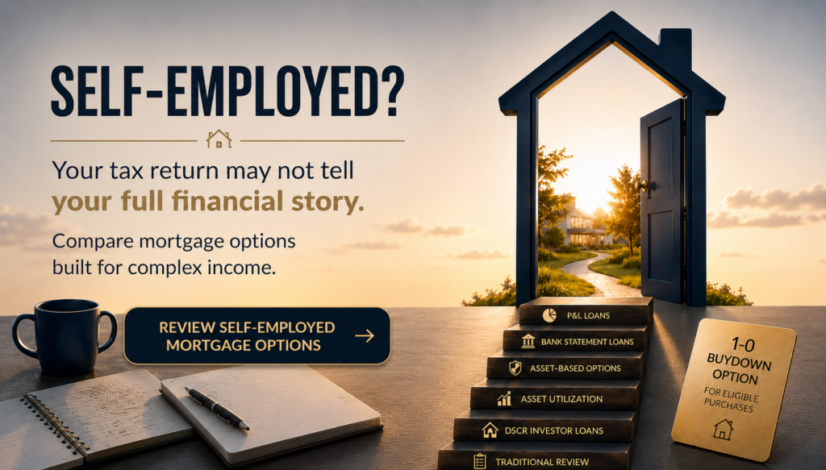
The Lending Mamba 1-0 Buydown Option
Self-employed buyers purchasing a primary residence should also ask about The Lending Mamba’s 1-0 Buydown offer.
The Lending Mamba is covering the cost of your 1-0 Buydown for eligible purchase transactions. This may help lower your payment in year one, giving eligible buyers more breathing room as they settle into homeownership.
For self-employed buyers, the first year of homeownership can be especially important because business income may be seasonal or variable. A year-one payment strategy may be helpful, but buyers should still understand the standard payment after year one.
Common Mistakes Self-Employed Borrowers Make
Mistake 1: Assuming tax returns are the only option.
Some borrowers may have alternative documentation paths worth reviewing.
Mistake 2: Waiting too long to organize documents.
Self-employed files often need more preparation.
Mistake 3: Mixing personal and business funds without clear records.
Clean documentation can make the process smoother.
Mistake 4: Ignoring reserves.
Many self-employed and non-QM options may require stronger reserves.
Mistake 5: Choosing a loan only because it approves faster.
Compare rate, APR, terms, costs, prepayment penalties, and long-term fit.
Mistake 6: Not reviewing all options.
Traditional, bank statement, P&L, asset-based, asset utilization, and DSCR options may all work differently.
Questions to Ask Before Applying
Self-employed borrowers should ask:
Q. Can I qualify with traditional tax returns?
Q. Would a P&L loan fit my file?
Q. Can bank statements support my income review?
Q. Can assets help my qualification strategy?
Q. Do I need a non-QM loan?
Q. What reserves are required?
Q. What down payment is needed?
Q. Are there prepayment penalties?
Q. What is the APR?
Q. What documents should I prepare?
Q. Can I use a 1-0 Buydown for my purchase?
Q. What will the payment be after year one?
How The Lending Mamba Helps
The Lending Mamba helps self-employed Californians compare mortgage options based on their real financial picture. We review:
- Traditional loan options
- P&L mortgage options
- Bank statement loans
- Asset-based options
- Asset utilization
- DSCR investor loans
- Non-QM possibilities
- Down payment strategy
- Reserves
- Closing costs
- 1-0 Buydown options
- Long-term affordability
Final Thoughts
Self-employed income can be complex, but that does not mean your mortgage strategy has to be confusing.
If your tax returns do not tell your full financial story, there may be other options worth reviewing, including P&L loans, bank statement loans, asset-based options, asset utilization, DSCR investor loans, and traditional mortgage paths. Start with a clear mortgage review.
The Lending Mamba
Call: 657-777-0024
Visit: www.thelendingmamba.com
Disclaimer: Eligibility, rates, terms, program availability, documentation requirements, down payment requirements, reserve requirements, and payment changes may vary. This content is for educational purposes only and is not a commitment to lend, guarantee of approval, or guarantee of savings. Speak with a licensed mortgage professional to review your specific situation.