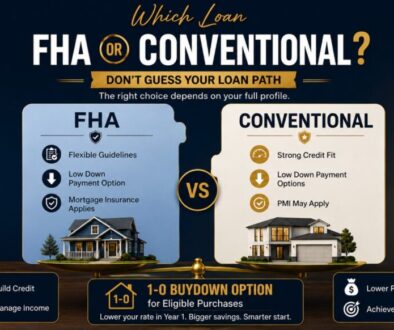

Buying a Home in California in 2027? Compare 1-0 Mortgage Buydowns, Seller Credits and Discount Points
If you are planning to buy a home in California in 2027, your biggest question may not be whether prices or mortgage rates will fall. It may be how to structure your financing so your first-year payment, cash needed at closing and longer-term costs all make sense.
Three options deserve a closer look: a temporary 1-0 mortgage buydown, seller credits toward eligible closing costs, and discount points that reduce the mortgage note rate. They sound similar, but they work differently. Understanding those differences can help buyers in Corona, Anaheim and across Southern California ask better questions before making an offer.
Why mortgage financing decisions matter heading into 2027?
Mortgage forecasts change as inflation, Treasury yields, economic growth and investor expectations shift. For example, Fannie Mae’s October 2026 housing outlook projected 30-year mortgage rates averaging about 7.5% in 2027. This is a forecast, not an offered mortgage rate or a guarantee of what buyers will pay. Rates offered to individual borrowers depend on the market at lock and the details of the application.
Rather than building a purchase plan around one prediction, compare today’s available loan structures and calculate whether the full payment works for your budget. That is especially important in higher-cost California markets, where property taxes, insurance and HOA assessments may materially affect affordability.
What is a 1-0 mortgage buydown?
A 1-0 temporary buydown subsidizes a borrower’s principal-and-interest payment for the first 12 months of a qualifying mortgage. During that first year, the payment is calculated as if the interest rate were one percentage point below the permanent note rate. Starting in month 13, the borrower pays principal and interest at the full note rate. The note rate itself does not change.
For example, imagine a 30-year, fixed-rate $500,000 loan with a hypothetical 6.50% note rate. The first-year 1-0 payment can be calculated using an effective 5.50% rate, after which the loan payment returns to the permanent 6.50% schedule. The borrower must qualify based on the required full payment under the applicable underwriting rules.
Illustrative payment comparison
| Scenario | Monthly principal & interest |
| Year 1, subsidized payment at 5.50% | $2,838.95 |
| Month 13 onward, note rate of 6.50% | $3,160.34 |
| Approximate first-year monthly difference | $321.39 |
| Approximate 12-month subsidy | $3,856.68 |
Example only. Calculations assume a $500,000 mortgage, 30-year amortization and unchanged contractual payment schedule; rounding may affect totals. These are NOT market quotes. Taxes, insurance, mortgage insurance, HOA dues and other costs are excluded. The buydown is funded in advance under an eligible agreement; it is not free financing.
The Lending Mamba 1-0 Buydown offer
The Lending Mamba is covering the cost of a 1-0 Buydown for eligible home purchase transactions. That can be worth asking about if you are buying a home and want a lower principal-and-interest payment during your first year while planning for the full payment that follows.
Mandatory offer disclaimer: The Lending Mamba 1-0 Buydown offer applies only to eligible agency or government purchase loans. Additional program, credit, property, underwriting, transaction and offer conditions may apply. Not every agency or government product permits the same temporary buydown structure; eligibility and current offer availability must be confirmed with The Lending Mamba. It is not an offer on all loans or a guarantee of approval.
What are seller credits in a California home purchase?
A seller credit is an agreed contribution from the seller toward certain allowable buyer costs at closing. Depending on the loan program and transaction, credits may help cover eligible closing expenses, prepaid items and sometimes a permitted temporary buydown. Seller concessions are subject to loan-program limits, appraisal and contract requirements, and closing-cost restrictions.
Seller credits are not normally a substitute for the minimum required down payment. They also do not automatically lower your mortgage interest rate. Their value depends on how they are applied and whether the final purchase terms remain competitive.
What are mortgage discount points?
Discount points are an upfront charge paid to the lender to obtain a lower permanent note rate than the otherwise comparable no-points offer. One point equals 1% of the loan amount, but one point does not equal a fixed reduction in interest rate. The reduction varies by lender, program and market conditions.
Unlike a 1-0 temporary buydown, discount points can reduce principal-and-interest payments beyond the first year. However, paying more upfront may not be beneficial if you sell or refinance before you recover the added initial cost.
1-0 Buydown vs. seller credits vs. discount points
| Option | Main benefit | Important trade-off |
| 1-0 temporary buydown | Reduced principal-and-interest payment for year one | Payment returns to full note-rate amount in year two |
| Seller credit | May reduce cash needed for eligible closing costs | Concession rules and limits apply; price negotiation matters |
| Discount points | Lower permanent mortgage note rate | Higher upfront costs; savings depend on loan holding period |
Which financing choice may fit a 2027 California homebuyer?
If your priority is the first year of ownership
Ask about a 1-0 buydown, especially if you anticipate initial moving or setup costs. Build your budget using the month-13 payment, not only the temporary first-year amount.
If your main challenge is cash to close
Ask whether a seller credit could offset allowable closing expenses. Get a full Loan Estimate that shows the down payment, lender fees, escrows, cash to close and the effect of any seller contribution.
If you expect to keep your mortgage for many years
Compare a zero-point mortgage with options that charge discount points. Request a break-even calculation based on incremental upfront cost divided by monthly savings, and remember that the actual outcome changes if you refinance or move.
If you are buying in Corona or Anaheim
Local purchase decisions should include insurance availability, property condition, commuting expenses and potential HOA dues. A mortgage structure that looks attractive on paper still needs to work with your complete housing budget.
Can buyers combine these options?
Sometimes. A transaction may include an eligible combination of concessions and financing features, but every loan type has rules about seller-paid costs, interested-party contributions, temporary buydowns and permissible funding sources. Buyers should not assume that multiple credits or concessions can be stacked without restrictions. Ask the lender to confirm the exact structure in writing.
Five questions to ask before you choose
- Q1. What is the full monthly payment after the first-year buydown expires, including taxes and insurance?
- Q2. Who funds the temporary buydown, and what happens to unused funds if the loan is paid off early?
- Q3. What is the cash-to-close difference between a seller credit and a lower purchase price?
- Q4. If I pay points, how long would it take to recover the cost from the monthly savings?
- Q5. Which parts of the quoted offer are confirmed on the Loan Estimate and which still require approval?
Why comparing Loan Estimates matters more than guessing rates?
The Consumer Financial Protection Bureau recommends comparing Loan Estimates for the same loan amount and loan type. Review the interest rate, APR, loan costs, lender credits, projected payment and cash to close. Ask your lender for side-by-side scenarios showing the 1-0 buydown, a standard mortgage without a temporary subsidy and any proposed discount-point or credit structure.
A lower first-year payment is useful only if the long-term loan remains comfortable. Do not assume a future refinance will be available or that future interest rates will be lower.
Frequently asked questions
Q1. Does a 1-0 buydown permanently lower my mortgage rate?
A. No. It temporarily reduces the borrower’s principal-and-interest payment for the first year. The mortgage note rate is unchanged.
Q2. Can I qualify using the lower first-year payment?
A. Not generally under Fannie Mae temporary buydown guidance; qualification is based on the full note rate. Other programs have their own underwriting requirements.
Q3. Are seller credits the same as discount points?
A. No. Seller credits are transaction contributions toward eligible costs. Discount points are upfront charges used to obtain a lower mortgage note rate. Under some circumstances, seller-paid costs may include allowable points, subject to program requirements.
Q4. Should I wait until 2027 to buy a California home?
A. There is no single answer. Consider your job stability, savings, available listings, total cost of ownership and financing options. Forecasts are uncertain, and timing solely around expected rates may not produce the best result.
Q5. Is The Lending Mamba 1-0 Buydown available on every loan?
A. No. Its stated promotion is limited to eligible agency or government purchase loans, with additional program and transaction conditions.
Talk to The Lending Mamba about your 2027 purchase plan
Before you commit to a home purchase in Corona, Anaheim or elsewhere in California, compare the financing structures side by side. The Lending Mamba can review whether an eligible 1-0 buydown, available seller credit or another purchase-loan setup fits your goals.
Call: 657-777-0024 | Website: https://thelendingmamba.com/ | Anaheim office: 5101 E La Palma Ave, Suite 204, Anaheim, CA 92807
General Disclaimer: Educational content only; not a commitment to lend or a rate quote. All financing is subject to credit approval, program rules, property eligibility and underwriting. Forecasts and programs may change. Confirm all current promotional terms before publishing or relying on the offer.