
FHA vs Conventional Loans in California: Which Mortgage Fits You Best?
Buying a home in California is one of the biggest financial decisions you’ll ever make. With rising home prices and multiple financing options available, choosing the right mortgage can significantly impact your monthly payment and long-term financial goals.
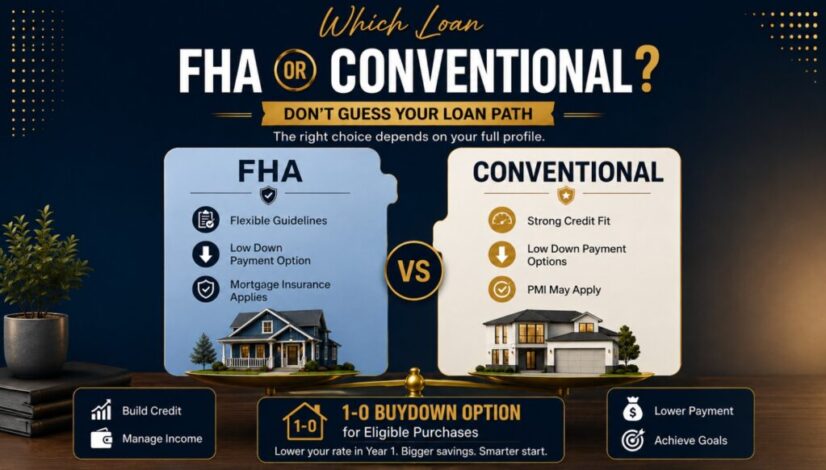
Two of the most popular home financing options are FHA loans and Conventional loans. But which one is right for you? In this guide, we’ll compare FHA vs Conventional loans in California, explore eligibility requirements, down payment options, mortgage insurance, and discuss how programs like the 1-0 Buydown option can help make homeownership more affordable.
What Is an FHA Loan?
An FHA loan is a government-backed mortgage insured by the Federal Housing Administration. It is designed to help first-time homebuyers and borrowers with lower credit scores qualify for home financing.
Key Benefits of FHA Loans
✔ Flexible lending guidelines
✔ Lower credit score requirements
✔ Down payments as low as 3.5%
✔ Higher debt-to-income ratios may be accepted
✔ Ideal for first-time home buyers
FHA Loan Requirements in California
To qualify for an FHA mortgage loan, borrowers generally need:
- A minimum credit score of 580 for a 3.5% down payment
- Steady employment and income history
- Primary residence occupancy
- Mortgage insurance premiums (MIP)
What Is a Conventional Loan?
A Conventional loan is a mortgage that is not insured or guaranteed by the government. These loans typically conform to standards set by Fannie Mae and Freddie Mac.
Key Benefits of Conventional Loans
✔ Competitive mortgage rates
✔ Low down payment options starting at 3%
✔ Potentially lower overall borrowing costs
✔ Private Mortgage Insurance (PMI) may be removed later
✔ Ideal for borrowers with strong credit profiles
Conventional Loan Requirements
Borrowers typically need:
- Higher credit scores (usually 620 or above)
- Stable income and employment
- Lower debt-to-income ratios
- Sufficient assets and reserves
FHA vs Conventional Loans: Side-by-Side Comparison
| Feature | FHA Loan | Conventional Loan |
|---|---|---|
| Minimum Down Payment | 3.5% | As low as 3% |
| Credit Score Requirement | More Flexible | Higher Credit Standards |
| Mortgage Insurance | Required for most loans | PMI may apply if under 20% down |
| Debt-to-Income Ratio | More Flexible | Typically Stricter |
| Loan Limits | FHA County Limits Apply | Higher Conforming Limits Available |
| Best For | First-Time Buyers, Lower Credit Scores | Borrowers with Strong Credit |
Down Payment Comparison
One of the biggest misconceptions is that conventional loans always require a large down payment.
FHA Loan Down Payment
- Minimum down payment: 3.5%
- Gift funds are generally allowed.
- Down payment assistance programs may be available.
Conventional Loan Down Payment
- Some programs allow down payments as low as 3%.
- Borrowers with higher credit scores may receive better interest rates.
Mortgage Insurance: FHA vs Conventional
FHA Mortgage Insurance
FHA loans require:
- Upfront Mortgage Insurance Premium (UFMIP)
- Annual Mortgage Insurance Premium (MIP)
In many cases, FHA mortgage insurance remains for the life of the loan.
Conventional Mortgage Insurance
Conventional loans may require Private Mortgage Insurance (PMI) when the down payment is less than 20%. However, PMI can often be removed once sufficient home equity has been built, potentially reducing monthly payments.
Which Loan Is Better for First-Time Home Buyers in California?
For many California first-time home buyers:
FHA Loans May Be Better If You:
- Have a lower credit score.
- Need flexible qualification guidelines.
- Have limited savings for a down payment.
- Recently recovered from credit challenges.
Conventional Loans May Be Better If You:
- Have strong credit.
- Want lower long-term borrowing costs.
- Can qualify for competitive interest rates.
- Want the possibility of removing PMI in the future.
Save More with a 1-0 Buydown Option
Home affordability remains a major concern for California buyers. That’s why many lenders now offer a 1-0 Buydown Program.
What Is a 1-0 Buydown?
A 1-0 Buydown temporarily lowers your mortgage interest rate during the first year of your loan.
Benefits of a 1-0 Buydown
✔ Lower monthly payments during Year 1
✔ Increased purchasing power
✔ Easier transition into homeownership
✔ Additional savings during the early years of ownership
How to Choose the Right Mortgage Option
Choosing between an FHA and Conventional loan depends on several factors, including:
- Credit score
- Income stability
- Available down payment
- Debt obligations
- Homeownership goals
- Long-term financial plans
Final Thoughts
Both FHA loans and Conventional loans offer unique advantages for California homebuyers.
If you need flexible qualification standards and lower credit requirements, an FHA mortgage may be the right choice. If you have strong credit and want long-term savings, a Conventional loan could be the better option.
Understanding your mortgage options and comparing loan programs carefully can help you make a confident and informed decision.
Frequently Asked Questions (FAQs)
Q. Is an FHA loan easier to qualify for than a Conventional loan?
Ans. Yes. FHA loans generally have more flexible credit and income requirements than conventional mortgages.
Q. Can first-time home buyers use Conventional loans?
Ans. Absolutely. Many conventional mortgage programs are specifically designed for first-time homebuyers and offer low down payment options.
Q. What credit score is needed for a Conventional loan?
Ans. Most lenders require a minimum credit score of 620, although higher scores often qualify for better rates.
Q. Is a 1-0 Buydown worth it?
Ans. A 1-0 Buydown can be beneficial for borrowers seeking lower monthly payments during the first year of homeownership.