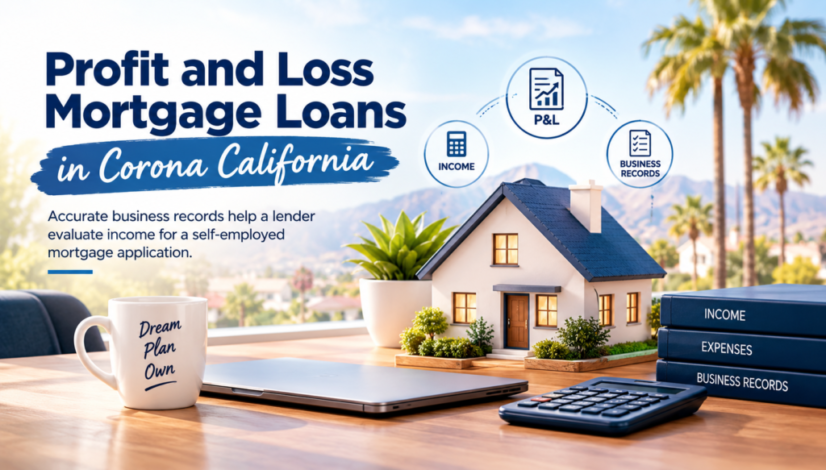
Profit and Loss Mortgage Loans in Corona, California
Running a business in Corona means your income may arrive through invoices, contracts or seasonal sales rather than a regular paycheck. When you apply for a mortgage, the lender needs to understand how much of that business income is stable and available to support the loan.
Profit and loss mortgage loans in Corona, CA, may offer an alternative documentation route for eligible self-employed borrowers. The useful starting point is a review of your business records, ownership and borrowing goal. A P&L statement can help explain your income, but it does not determine approval on its own.
What a profit and loss mortgage loan is?
A profit and loss statement, often called a P&L or income statement, summarizes business revenue and expenses over a defined period. In a P&L mortgage program, a lender uses an acceptable prepared statement as part of its income qualification process. The preparer, reporting period and supporting records depend on the program.
Angel Oak’s P&L program, for example, describes one-year and two-year statement options for self-employed borrowers. Its published requirements distinguish P&L-only documentation from a version supported by bank statements. These are examples of one provider’s criteria, not universal terms or confirmed offers through The Lending Mamba.
How this differs from a P&L in a conventional loan?
A P&L also has a role in conventional underwriting. Fannie Mae’s guidance allows lenders to use one to help assess whether self-employed income is stable or likely to continue. That does not mean a standalone P&L automatically replaces the tax-return requirements of a conventional mortgage.
Fannie Mae’s separate self-employment documentation guidance addresses tax returns, income history and the business’s ability to distribute income while remaining viable. Ask your mortgage professional to compare the conventional route with an alternative P&L program before assuming you need a specialty loan.
Who may want to explore this option?
A contractor, consultant, shop owner or other self-employed borrower may want a P&L review when business records require more explanation than a pay stub can provide. Bring the same accurate financial picture to each lender. A different documentation method should not require changing legitimate expenses or overstating profit.
These programs are often described as non-QM, meaning non-qualified mortgage. Repayment ability still matters. The CFPB explains that most mortgage lenders must make a reasonable, good-faith determination of the borrower’s ability to repay. For a home you will occupy, explain that intended use from the start.
Prepare the statement the lender will accept
Before paying to have a new report prepared, get the lender’s checklist. Ask which professional may prepare it, whether a signature or letterhead is required, what dates it must cover and whether an updated year-to-date statement is needed.
- Identify the business and your ownership – Have the legal name, entity structure, ownership evidence and operating history ready. Explain any recent ownership change.
- Use a consistent reporting period – Label the start and end dates and explain seasonal or unusual income. A strong month does not establish a full year of earnings.
- Keep supporting records available – Organize statements, bookkeeping reports and other records requested by the lender. Ask how transfers, refunds or unusual deposits should be documented.
- Separate business profit from available cash – Explain unpaid invoices, upcoming bills and funds needed for operations. A profitable statement does not tell the lender everything about liquidity.
Bank statement requirements vary by program
Acra Lending’s published P&L program calls for a licensed tax preparer’s statement, one year plus year-to-date information, and three months of bank statements. That differs from programs advertising a P&L-only route. Both the preparer and the supporting evidence need to match the selected program.
Ask whether statements are being requested to support income, verify funds for closing or document reserves. Those are different purposes. “P&L only” describes an income-documentation option; it should not be read as “the lender will never ask for a bank statement.”
An example of profit and monthly income
Consider this simplified illustration for a borrower who owns the entire business. It shows the arithmetic before any lender adjustments or other qualification checks.
| Hypothetical full year P&L item | Amount |
| Business revenue over 12 months | $480,000 |
| Business expenses over the same period | $360,000 |
| Net profit for the period | $120,000 |
| Monthly equivalent from $120,000 divided by 12 | $10,000 |
The $40,000 average monthly revenue is not the same as $10,000 of monthly net profit. Even the latter is only a starting figure here. The lender must decide what income it accepts after reviewing the program, ownership, income trends and supporting information. Do not add owner compensation or distributions again if that would count the same income twice.
These invented figures are not a qualification formula, a loan quote or a forecast of approval. A jointly owned business, a shorter reporting period or declining income can require a different analysis.
Compare the main documentation routes
| Mortgage route | Evidence typically reviewed | Question to ask |
| Conventional self-employed loan | Tax-return income and related records under agency requirements | Can the documented income support a conventional loan? |
| P&L mortgage program | Prepared business profit and loss statement, with supporting records as required | Does the statement and its preparer meet this program’s rules? |
| Bank statement mortgage | Eligible deposits with the lender’s expense and income adjustments | Which deposits count and how are business expenses treated? |
| DSCR investment property loan | Rental-property income under the selected program’s calculation | Is this an eligible rental investment rather than a home I intend to occupy? |
Bank statement lending is a separate method, not simply a P&L without an accountant. Angel Oak’s bank statement program describes reviewing personal or business statements and applying expense treatment to eligible business deposits. Comparing the same file under different methods can clarify which records best support the borrowing request.
If you are buying a rental, our California DSCR guide explains the property-income approach. For a wider comparison of personal mortgage documentation options, see our California self-employed mortgage guide.
Compare the cost as well as the income calculation
For a consumer home mortgage, compare the Loan Estimates provided for your scenario. The CFPB’s comparison guide highlights the loan amount, payment, upfront charges, lender credits and cash needed to close. Use the same loan amount and term when possible, and check when each rate was quoted and whether it is locked.
Ask whether the rate can adjust, whether the payment includes principal, and whether there is an interest-only period or balloon payment. Confirm any early-payoff restrictions or charges that apply to the specific transaction. Request an explanation of every cost you do not recognize.
For example, an offer that costs $2,400 more upfront and saves $80 per month has a simple 30-month recovery period. That calculation excludes differences in principal balances, changing payments and exit costs. It is a comparison exercise, not a reason to choose one loan without reading its terms.
Protect the cash your business needs
Before using business funds for a down payment, map out what must remain available for payroll, suppliers, taxes and the next slow period. Ask the lender how the withdrawal will be evaluated. Fannie Mae’s self-employment guidance specifically calls for analysis when business assets are used for closing costs, a down payment or reserves and business income is also used to qualify.
For a Corona property, build your household budget around the full housing cost, including taxes, insurance and any HOA dues. Then test that budget against a slower business month. A lender’s maximum approval and your preferred monthly commitment answer different questions.
Frequently asked questions
Q1. Do all P&L mortgages require a CPA?
A. No single preparer rule applies to every program. Published examples refer to CPAs or tax preparers, with different credential and format requirements. Confirm who is acceptable before ordering a report. A statement prepared only by the borrower may not meet the selected lender’s criteria.
Q2. Can I use a P&L instead of tax returns?
A. Some alternative programs allow that income-documentation route. Conventional loans have their own requirements, and a P&L may serve as supporting evidence there. Ask which program is being considered and get its actual document checklist.
Q3. How much down payment will I need?
A. That depends on the lender, property, credit profile and transaction. On a hypothetical $700,000 purchase, a $560,000 loan leaves $140,000 of purchase price to fund, before closing costs and any required reserves. This example illustrates arithmetic, not available terms.
Q4. Can a new business qualify?
A. A recently started business needs a specific eligibility review. Ask about operating-history requirements, ownership history and any relevant prior work experience. Do not assume that a statement covering a short profitable period will satisfy the program.
Q5. Can I refinance with a P&L mortgage?
A. Some programs include rate-and-term or cash-out refinancing, subject to current criteria. Review the new payment, fees, equity position and funds remaining afterward. Accessing cash does not automatically make a refinance worthwhile.
Start with a self-employed mortgage review
At The Lending Mamba, we help Corona borrowers review how their business income and documents fit available mortgage options. Start with your purchase or refinance goal, business ownership details, reporting history and estimated funds for closing. We can discuss the documentation route before you commit to a loan application strategy.
Call 657-777-0024 or request your self-employed mortgage review. Ask how a P&L, bank statement or conventional income review would apply to your situation.
Disclaimer
This article is for general educational purposes and is not a loan offer, rate quote, approval guarantee, commitment to lend or financial, investment, tax or legal advice. Program availability, qualifying-income calculations, preparer requirements, documentation, rates, fees, down payments and other terms vary by lender and may change. All financing is subject to underwriting and approval. Examples are hypothetical. External providers are cited for explanation and do not establish affiliation or program availability through The Lending Mamba. Consult qualified mortgage, tax and legal professionals about your circumstances.